How to Compost at Home: A Simple Guide for Beginners
This guide contains affiliate links. As an Amazon Associate, Simple Garden Hub earns from qualifying purchases, at no extra cost to you.
Composting turns kitchen scraps and yard waste into dark, crumbly material that feeds your soil for free. It sounds technical, but nature does the work. Your job is to give it the right mix of ingredients, some air and some moisture.
- Mix: about 1 part “greens” (food scraps, fresh clippings) to 2 or 3 parts “browns” (dry leaves, cardboard).
- Moisture: as damp as a wrung-out sponge.
- Air: turn or stir it every week or two.
- Time: 2 to 6 months if you turn it; up to a year if you do not.
How composting works
Bacteria, fungi and worms eat organic waste and break it down. They need four things: carbon (browns), nitrogen (greens), water and air. Get the balance roughly right and the pile heats up and shrinks. Get it wrong and it either smells or just sits there. That is all the science you need.
Choose a composting method
| Method | Best for | Good to know |
|---|---|---|
| Open pile or simple bin | Yards with space and lots of leaves | Cheapest. Aim for at least 3 feet wide, deep and tall so it holds heat |
| Enclosed bin | Small yards | Tidy and keeps animals out; harder to turn |
| Tumbler | Small yards and patios | Sealed and easy to turn; makes smaller batches |
| Worm bin | Apartments and indoors | Worms eat kitchen scraps; no yard waste needed |
Not sure which suits you? Our article on how a composting bin works goes through the benefits in more depth.
Fill one side while the other finishes. A few spins replace turning with a fork.
What to compost, and what to leave out
“Greens” and “browns” are about what the material does, not its color. Coffee grounds are brown in color but count as a green, because they are moist and rich in nitrogen.
A few more notes on what to add:
- Eggshells are fine. Crush them, as they break down slowly.
- Citrus peel and onion are fine in a pile or bin in moderate amounts, but go easy on them in a worm bin.
- Chop large pieces. Smaller scraps break down much faster.
Leave out meat, fish, bones, dairy and oily food, which smell and attract animals. Also skip pet waste, diseased plants, and weeds that have gone to seed, since a home pile rarely gets hot enough to kill them.
How to compost in 5 steps
- Pick a spot. Choose level ground with some shade, close enough to the kitchen that you will actually use it. Set a pile or open-bottomed bin directly on soil so worms can move in.
- Start with browns. Lay down 4 to 6 inches of twigs or dry leaves. This lets air in at the bottom.
- Add greens and browns in layers. Every time you add a bucket of kitchen scraps, cover it with two or three buckets of browns. Covering food also keeps flies away.
- Keep it damp. Squeeze a handful: it should feel like a wrung-out sponge. Add water if it is dry, and browns if it is soggy.
- Turn it. Mix the pile with a garden fork every week or two, or spin your tumbler every few days. Air speeds everything up and prevents smells.
Save your autumn leaves. Greens arrive all year from the kitchen, but browns are scarce in summer. Keep a bag or bin of dry leaves next to the compost so you always have some to add.
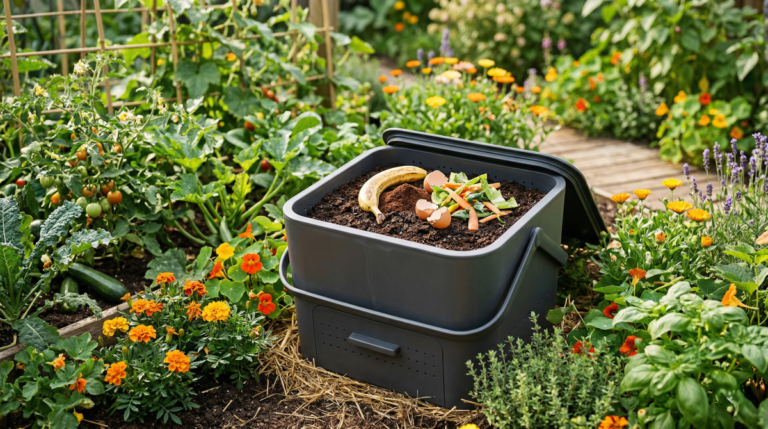
Holds a few days of scraps indoors. The charcoal filter in the lid stops smells.
How long does compost take?
It depends on how much attention you give it:
- Hot, well-managed pile (good balance, turned often): 2 to 4 months.
- Tumbler: often 2 to 3 months in warm weather.
- Pile you rarely turn: 6 months to a year. It still works. It is just slower.
Everything slows down in winter. That is normal, and the pile picks up again in spring.
Troubleshooting
| Problem | Cause | Fix |
|---|---|---|
| Smells rotten or like ammonia | Too wet, or too many greens | Mix in plenty of browns and turn it |
| Nothing is happening | Too dry, too small, or too few greens | Add water and greens; build the pile bigger |
| Flies around the bin | Food scraps left exposed | Bury scraps in the middle and cover with browns |
| Animals digging in | Meat, dairy or oily food; open pile | Remove those items; use an enclosed bin or tumbler |
| Wet and slimy | Rain, or too many grass clippings | Add shredded cardboard or leaves; cover the pile |
How to tell when compost is ready
Finished compost is dark brown, crumbly and smells like a forest floor. You should not be able to recognize what went in, apart from the odd eggshell or twig. If it is still warm or smells sour, give it more time. Sift out any big pieces and toss them back into the next batch.
How to use compost
- Garden beds: spread 1 to 2 inches over the surface each spring or fall. See raised bed gardening for beginners.
- Planting holes: mix a few handfuls into the soil when setting out tomatoes, squash and other hungry plants.
- Pots: blend up to one part compost with three parts potting mix. Our container gardening guide has more.
- Mulch: a layer around plants holds moisture and feeds the soil as it breaks down.
Frequently asked questions
Does compost smell?
A healthy pile smells earthy. A bad smell means it is too wet or has too many greens. Add browns and turn it, and the smell goes within days.
Can I compost in winter?
Yes. Keep adding scraps and browns. The pile will slow or freeze, then start working again when the weather warms.
Can I compost if I live in an apartment?
Yes. A worm bin fits under a sink or on a balcony and handles most fruit and vegetable scraps. Many cities also collect food scraps or have drop-off sites.
Do I need a compost starter or activator?
No. The microbes are already on your scraps and in the soil. A shovelful of garden soil or finished compost is all the starter a new pile needs.