Grow Lights for Indoor Plants: A Simple Guide for Beginners
This guide contains affiliate links. As an Amazon Associate, Simple Garden Hub earns from qualifying purchases, at no extra cost to you.
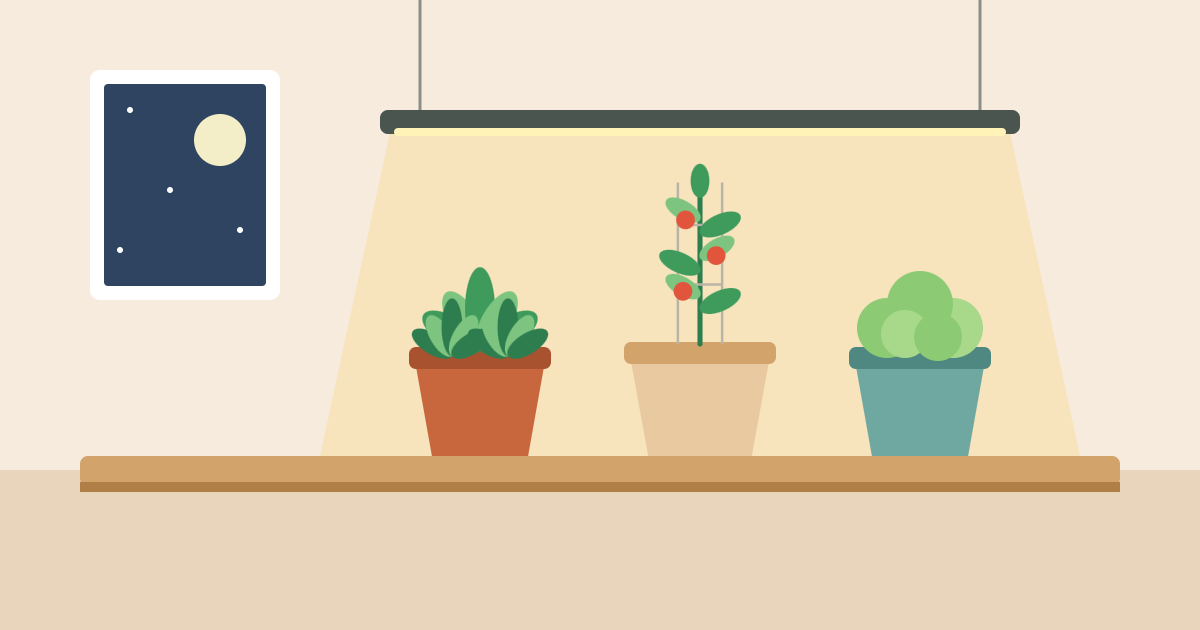
A grow light lets you raise seedlings, herbs and houseplants anywhere in your home, at any time of year. The products are easy to use. The packaging is not: it is full of numbers and jargon. This guide explains the few things that actually matter.
- Buy: a white, “full spectrum” LED grow light.
- Size it by actual watts, not “equivalent” watts: roughly 20 to 40 watts per square foot of plants for seedlings, herbs and greens.
- Hang it close: a few inches above seedlings for tube-style lights, 12 to 24 inches for stronger panels.
- Run it 12 to 16 hours a day on a timer.
Do you need a grow light?
Indoors is much darker than it looks. Our eyes adjust, but plants cannot: even a bright room gives a small fraction of the light found outdoors. You probably need a grow light if:
- you are starting seeds indoors in late winter;
- your herbs or houseplants grow tall, pale and floppy, or lean hard toward the window;
- you have no south-facing window, or it is winter and the days are short;
- you want to grow food indoors all year.
Types of grow lights
| Type | Good for | Running cost | Heat | Verdict |
|---|---|---|---|---|
| LED | Everything | Lowest | Low | Best choice for almost everyone |
| Fluorescent (T5 tubes, CFL) | Seedlings, greens, herbs | Moderate | Low to moderate | Fine if you already own one |
| Incandescent “plant bulbs” | Very little | High | High | Avoid: mostly heat, little useful light |
| HID (metal halide, sodium) | Large grow rooms | High | Very high | Overkill for a home |
LEDs use the least electricity, give off little heat, and last for years. Unless you already have fluorescent tubes, buy LED.
What the numbers on the box mean
Spectrum: choose white “full spectrum”
Plants use mostly red and blue light, which is why some grow lights glow purple. Those work, but white full-spectrum LEDs grow plants just as well, and they let you see the true color of the leaves, so you spot problems sooner. They are also much nicer to live with.
Color temperature (K)
Measured in kelvin. Lights rated around 5000 to 6500K give a cool, daylight white that suits seedlings and leafy growth. Around 2700 to 3000K is a warm white that suits flowering and fruiting. If you are buying one light for general use, pick something in the 4000 to 6500K range.
Watts: look for the actual power draw
Ignore “1000W equivalent” claims. Find the actual wattage, the power the light really uses, which is often in the small print. As a rough guide for LED lights:
- Seedlings, herbs and leafy greens: about 20 to 40 actual watts per square foot of growing area.
- Fruiting plants such as tomatoes and peppers: more, around 40 watts per square foot or above.
- A single houseplant: a 10 to 20 watt bulb or clip-on light is usually plenty.
PPFD and PAR
These measure the light plants can actually use, and they are the most accurate way to compare lights. Good manufacturers publish a PPFD chart showing the light level at different heights. If a light has no such information at all, treat the marketing claims with caution.
Which style of light should you buy?
Clip-on or desk light
Flexible arms clamp to a shelf or table. Ideal for a few herbs or a houseplant.
Grow bulb
Screws into a normal lamp socket. The simplest way to help a single plant.
LED bar or tube lights
Long, slim lights that hang over trays or mount under shelves and cover them evenly.
LED panel
A stronger, square light for a larger area or for plants that flower and fruit.
Clamps onto a shelf, with bendable arms and a built-in timer. An easy first grow light.
Linkable bars that hang over seed trays or mount under a shelf.
Turns a lamp you already own into a plant light.
How far should the light be from the plants?
Light fades quickly with distance, so closer is stronger. Typical starting points:
| Light | Distance above plants |
|---|---|
| LED or fluorescent tubes and bars | 2 to 6 inches |
| Clip-on lights and grow bulbs | 6 to 12 inches |
| LED panels | 12 to 24 inches |
Always check the maker’s recommendation, then let the plants tell you:
- Too far: stems stretch, plants lean, and new leaves are small and pale. Move the light closer.
- Too close: leaves nearest the light bleach, curl or turn crispy. Raise the light.
How many hours a day?
Plants need a dark period to rest, so do not leave lights on around the clock. A plug-in timer costs very little and keeps the schedule steady, which plants prefer.
If your plants also get window light, you can run the grow light for fewer hours. Use it to extend the day in the morning or evening.
Set it once and the light switches on and off by itself every day.
What does a grow light cost to run?
Less than most people expect. A 20-watt LED running 14 hours a day uses about 0.28 kilowatt-hours a day, or roughly 8.4 a month. At an electricity price of 16 cents per kilowatt-hour, that is about $1.35 a month. To work out your own cost, multiply watts by hours, divide by 1,000, and multiply by your electricity rate.
Frequently asked questions
Can I use a regular LED bulb as a grow light?
For low-light houseplants, a bright daylight LED bulb placed close to the plant can help. For seedlings, herbs and vegetables, a light made for plants gives much better results.
Are grow lights safe to leave on while I am out?
Quality LED lights run cool and are designed for long hours. Use a timer, keep lights away from water and fabric, and buy products with a recognized safety certification.
Do grow lights help houseplants in winter?
Yes. A few extra hours of light a day keeps many houseplants growing through the dark months instead of sulking.