Indoor Herb Garden for Beginners: How to Grow Fresh Herbs All Year
This guide contains affiliate links. As an Amazon Associate, Simple Garden Hub earns from qualifying purchases, at no extra cost to you.
You do not need a yard, or even warm weather, to grow something you can eat. A few pots of herbs on a bright windowsill will give you fresh basil, chives and mint all year. Indoor herbs fail for two main reasons, too little light and too much water, and both are easy to fix.
- Light: a south-facing window with 6 or more hours of direct sun, or an LED grow light for 12 to 16 hours a day.
- Easiest herbs: chives, mint, parsley, basil, thyme, oregano.
- Pots: at least 6 inches wide, with drainage holes, filled with potting mix.
- Water: only when the top inch of soil feels dry.
Step 1: Find your light
Light is the one thing you cannot skimp on. Herbs are sun-lovers, and even a bright room is far dimmer than the outdoors.
- South-facing windows (in the Northern Hemisphere) get the most sun and suit every herb.
- East or west windows get about half a day of sun, enough for mint, parsley and chives.
- North windows are too dim for herbs without a grow light.
When to use a grow light
In winter, days are short and the sun is weak, so even a south window may not be enough. If your herbs grow tall, pale and floppy, they are stretching for light. A small LED grow light solves it: hang or clip it 6 to 12 inches above the plants and run it for 12 to 16 hours a day. A plug-in timer makes this automatic.
Clips to a shelf or table edge and turns any corner into a growing spot. Look for one with a built-in timer.
Step 2: Choose easy herbs
| Herb | Difficulty | Light | Water | Good to know |
|---|---|---|---|---|
| Chives | Easy | 4 to 6 hours | Keep evenly moist | Snip to 1 inch and they regrow |
| Mint | Easy | 4 to 6 hours | Keep evenly moist | Give it its own pot; it takes over |
| Parsley | Easy | 4 to 6 hours | Keep evenly moist | Slow from seed; buy a young plant |
| Basil | Easy | 6 to 8 hours | Keep evenly moist | Hates cold drafts; pinch tips often |
| Thyme | Easy | 6 to 8 hours | Let it dry out between waterings | Prefers being a little dry |
| Oregano | Easy | 6 to 8 hours | Let it dry out between waterings | Trim often to keep it bushy |
| Rosemary | Trickier | 6 to 8 hours | Let it dry out between waterings | Needs strong light and good airflow |
| Cilantro | Trickier | 4 to 6 hours | Keep evenly moist | Short-lived; re-sow every few weeks |
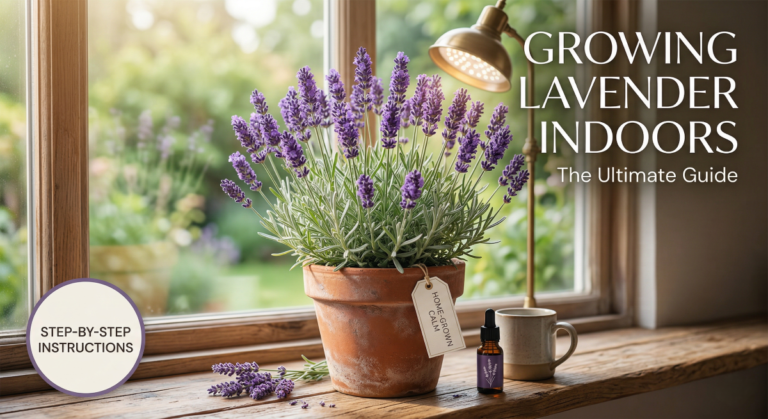
For your first try, pick three: chives, mint and basil cover most kitchen needs and recover quickly from mistakes. If you enjoy fragrant plants, lavender can also be grown inside. See how to grow lavender indoors.
Seeds or plants? Young plants from a garden center give you herbs to pick within a couple of weeks. Seeds are cheaper but take 6 to 10 weeks. Basil and chives are easy from seed; buy parsley, thyme, oregano and rosemary as plants.
Step 3: Pots and soil
- Drainage holes are essential. Without them, water pools at the bottom and roots rot. Stand each pot on a saucer to protect the windowsill.
- Go for 6 inches or wider. Tiny pots dry out in a day and cramp the roots.
- Use potting mix, never garden soil. Garden soil packs down in pots and can carry pests indoors. Our guide to choosing potting soil explains what to look for.
- Group herbs by thirst. If you share a planter, put the moisture-lovers (basil, parsley, chives) together and the dry-lovers (thyme, oregano, rosemary) together.
Pots sized to fit a sill, with holes for drainage and trays to catch the drips.
Step 4: Water the right way
More indoor herbs die from overwatering than from anything else. Use the finger test: push a finger an inch into the soil. If it feels dry, water. If it feels damp, wait.
- Water slowly at the base until water runs out of the drainage holes.
- Let it drain for 15 minutes, then empty the saucer. Herbs should never sit in standing water.
- Check again in a few days. Most indoor herbs need water once or twice a week; less in winter, more under grow lights or near a heater.
Yellow lower leaves and tiny black flies hovering around the soil (fungus gnats) are both signs of soil that is staying too wet. Let the top inch or two dry out fully before watering again.
Step 5: Harvest so they keep growing
Picking herbs the right way makes them bushier and more productive.
- Never take more than a third of the plant at once. It needs leaves to regrow.
- Basil, mint and oregano: snip a stem just above a pair of leaves. Two new stems will grow from that point.
- Chives and parsley: cut the outer leaves near the base and leave the center to keep growing.
- Pinch off flower buds on basil as soon as you see them. Once basil flowers, the leaves turn bitter.
Feeding, temperature and other care
- Fertilizer: potting mix runs out of nutrients after a couple of months. Feed with a liquid fertilizer at half the label strength every 3 to 4 weeks in spring and summer, and less often in winter.
- Temperature: herbs like the same range you do, about 60 to 75°F. Keep leaves from touching cold window glass, and keep pots away from heating vents.
- Turn the pots a quarter turn each week so plants grow straight and do not lean toward the window.
A liquid feed is the easiest type to dilute to half strength for potted herbs.
Common problems and quick fixes
| What you see | Likely cause | Fix |
|---|---|---|
| Tall, thin, pale stems | Not enough light | Move to a sunnier window or add a grow light |
| Yellow lower leaves, damp soil | Overwatering | Let the soil dry out; check the drainage holes |
| Drooping, with dry soil | Underwatering | Water thoroughly; it should perk up within hours |
| Brown, crispy leaf tips | Dry air or heat from a vent | Move away from heat sources |
| Basil with black patches | Cold damage | Move away from cold glass and drafts |
Frequently asked questions
What is the easiest herb to grow indoors?
Chives and mint. Both tolerate lower light than most herbs and bounce back quickly after cutting.
Can I grow herbs indoors in winter?
Yes. Growth slows in the short days of winter, so harvest lightly, water less, and consider a grow light to keep plants productive.
Can I keep a supermarket herb pot alive?
Often, yes. Those pots hold dozens of crowded seedlings. Gently split the root ball into three or four clumps and replant each in its own pot with fresh potting mix.