How Often Should You Water a Vegetable Garden? A Simple Guide
This guide contains affiliate links. As an Amazon Associate, Simple Garden Hub earns from qualifying purchases, at no extra cost to you.
Watering is where most new gardeners go wrong, usually by watering a little every day. Vegetables do far better with fewer, deeper drinks. Here is how much to give, how often, and how to tell when your garden actually needs it.
Most vegetable gardens need about 1 inch of water per week, including rain. Give it in 2 or 3 deep soakings, not a daily sprinkle. In hot weather (above 90°F), sandy soil, raised beds and containers, you will need to water more often. Always check the soil first: if it is dry 2 inches down, it is time to water.
How much is “1 inch of water”?
One inch of water means enough to cover the whole bed in water an inch deep, if it did not soak in. In practical terms:
- 1 inch of water is about 0.6 gallons per square foot.
- A 4 x 8 foot raised bed (32 square feet) needs about 20 gallons a week.
- That is ten fills of a standard 2-gallon watering can, spread over the week.
A cheap rain gauge tells you how much the weather has already delivered, so you only make up the difference. To measure a sprinkler, set an empty tuna can in the garden and time how long it takes to fill to 1 inch.
Why deep watering beats daily watering
Roots grow where the water is. A quick daily sprinkle wets only the top inch of soil, so roots stay near the surface, where they dry out by the next afternoon. A long soak reaches 6 to 8 inches down. Roots follow it, and deeper roots can ride out hot, dry days.
To check your own watering, wait an hour after you finish, then dig a small hole with a trowel. The soil should be moist at least 6 inches down.
How often to water, by situation
| Situation | How often | Notes |
|---|---|---|
| In-ground garden, mild weather | 1 to 2 times a week | Skip a watering after a good rain |
| Raised beds | 2 to 3 times a week | They drain and dry faster than the ground |
| Hot spells (90°F and up) | Every 1 to 2 days | Plants may need up to 2 inches a week |
| Containers and pots | Daily in summer | Small pots may need water twice a day in a heat wave |
| Seeds and new seedlings | Lightly, every day | Keep the top inch damp until roots establish |
| Sandy soil | More often, smaller amounts | Water drains straight through |
| Clay soil | Less often, slowly | Clay holds water for days but absorbs it slowly |
Seedlings are the exception to the deep-watering rule. Their roots are only an inch or two long, so they need the surface kept moist. Switch to deeper, less frequent watering once plants are a few inches tall.
The finger test: the only schedule you need
No calendar knows your soil or your weather. Before you water, push a finger into the soil up to the second knuckle, about 2 inches.
- Dry at your fingertip? Water now.
- Cool and damp? Check again tomorrow.
- Wet or muddy? Wait a few days.
If you would rather not get your hands dirty, a simple probe does the same job.
Push the probe in near the roots and read the dial. No batteries needed.
The best time of day to water
Early morning is best. The air is cool, so less water evaporates, and leaves dry quickly once the sun is up, which helps prevent fungal diseases.
Evening is the second choice. It works, but leaves that stay wet overnight are more likely to develop mildew and blight, so aim the water at the soil. Midday watering will not burn the leaves, despite the old myth, but more of it is lost to evaporation. If plants are badly wilted at noon, water them anyway.
The best ways to water
Soaker hose or drip line
Delivers water slowly, right at the soil. Leaves stay dry and very little is wasted.
Watering can or hose wand
Water at the base of each plant until it runs from the drainage holes.
Overhead sprinkler
Easy, but it wets the leaves and loses water to wind and evaporation. Use it in the morning only.
Lay it along your rows, cover it with mulch, and turn the tap on low for 30 to 60 minutes.
Turns the water on and off for you, which is handy for early mornings and holidays.
Mulch: the easiest way to water less
A 2 to 3 inch layer of straw, shredded leaves or grass clippings shades the soil and slows evaporation. Mulched beds can need noticeably less water, and they grow fewer weeds too.
Signs of too little and too much water
| Too little water | Too much water |
|---|---|
| Leaves wilted in the morning, not just in afternoon heat | Leaves wilted even though the soil is wet |
| Dry, crispy leaf edges | Lower leaves turning yellow |
| Soil pulling away from the edge of the bed or pot | Soil that smells sour, or green algae on top |
| Small or misshapen fruit; bitter cucumbers | Soft, rotting stems at the soil line |
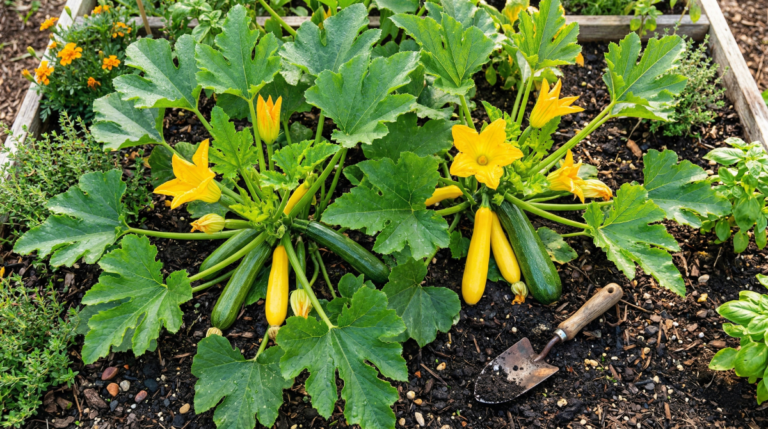
Wilting in the afternoon is not always thirst. Squash, cucumbers and tomatoes often droop in strong afternoon sun to save water, then recover by evening. Check the soil before you reach for the hose. Overwatering kills as many plants as drought.
Uneven watering, swinging between bone dry and soaked, also causes problems of its own, such as cracked tomatoes and blossom end rot (a dark, sunken patch on the bottom of the fruit). Steady moisture and mulch are the fix.
Which vegetables need the most water?
- Thirstiest: cucumbers, celery, lettuce and other leafy greens, squash, and tomatoes once fruit is forming.
- Critical times: any crop when it is flowering and setting fruit, and root crops while roots are swelling.
- More tolerant of dry spells: established peppers, beans, Swiss chard, and herbs such as rosemary and thyme.
Choosing what to grow? See the 10 easiest vegetables for beginners.
Frequently asked questions
Should I water my vegetable garden every day?
Usually not. Daily watering is only needed for seedlings, containers, and during heat waves. For established plants in beds, 2 or 3 deep waterings a week grow stronger roots.
How long should I run a soaker hose?
Start with 30 minutes, then dig down to check how far the water reached. Adjust until the soil is moist 6 inches deep. For many gardens that is 30 to 60 minutes, twice a week.
Is it OK to water at night?
It is better than not watering, but leaves that stay wet all night invite disease. If evening is your only option, water the soil, not the plant.